The Headline’s Verb: What It Says, and What It Suggests
Headline verbs can make a proposal sound settled or an allegation sound proven. Learn to read them closely and share only what the wording supports.

The most common mistake with a headline verb is to treat it as a complete account of what happened. With a headline such as “Council approves housing plan”, a reader might infer that building work is about to begin, although the vote may only settle one stage of a longer process. Reading the verb closely helps keep an action separate from the outcome readers may infer.
A verb names an action or state, but it also signals agency, certainty and judgement. “Says”, “plans” and “rules” make different commitments, so the precise wording matters more than whether a headline sounds forceful.
What verbs commit to
Ask what the verb literally says happened. “Says” reports a statement, not its truth; “plans” reports an intention, not a completed action; and “may” or “could” marks possibility. “Votes” describes a decision-making act, but the result and its practical effect may need separate explanation.
Other verbs carry additional implications. “Confirms” suggests verification, “alleges” marks a claim that remains unproven, and “admits” frames a statement as a concession. “Reveals” suggests that information was hidden or newly uncovered. These words may fit, but the story should make clear what supports that framing.
Focus on the difference between an event and its status. A council can approve a proposal without work beginning; a court can hear a case without deciding it. A concise headline may name the first action while leaving the later result unstated.
Separate event from consequence
Headlines often compress a chain of events into one vivid verb. “Threatens”, “triggers” or “clears the way” may describe a predicted effect rather than something that has already happened. Look for the mechanism: what action is said to cause what consequence, and is that consequence reported or anticipated?
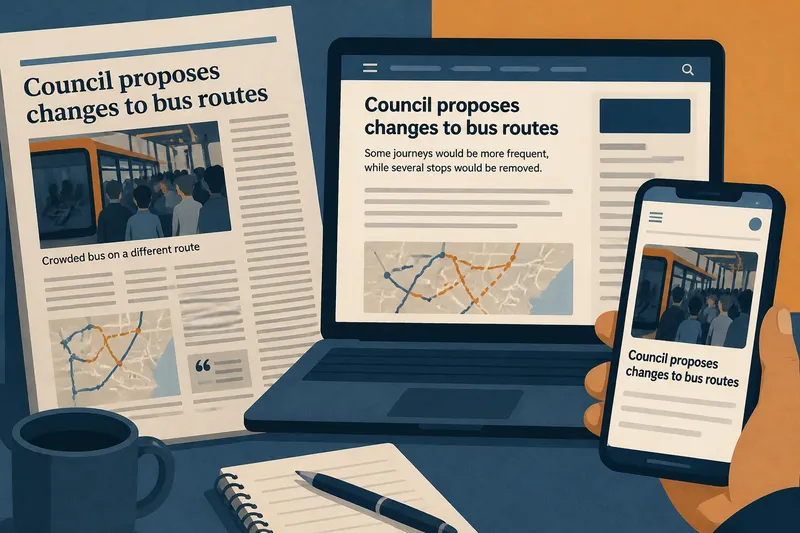
Imagine a local paper runs “New bus route threatens village shops”. The starting point is a proposed route that has not been approved; the article says shop owners worry it may divert passing customers. The verb describes their concern about a possible effect, not a demonstrated loss of trade. A careful retelling would say that shop owners fear the proposed route could affect their businesses.
Read the subject carefully
Identify who or what performs the action. “Minister backs inquiry” says the minister supports it, while “Minister faces calls to back inquiry” reports pressure and does not establish support. The difference sits in the verb and the phrase around it, not just in the names mentioned.
Then check the object and result. A company may challenge a decision without overturning it; an official may criticise a policy without changing it. Keeping those parts distinct prevents a reported action from becoming an assumed outcome.
Notice loaded wording
Some verbs carry judgement as well as description. “Slams” makes criticism sound forceful, “claims” can make a statement sound doubtful, and “admits” hints at a concession. Compare the headline’s wording with a plainer description, then ask whether the article gives a reason for the stronger choice.
For example, “Company admits product flaw” implies a concession. If the story only reports that the company announced a flaw, “Company says product has a flaw” describes the statement without adding that implication. The distinction is useful even when the headline’s wording is defensible: it helps you see where observation ends and interpretation begins.
Metaphors need the same check. A policy that “hits” households or a decision that “opens the door” to change may summarise an indirect effect. Look for the concrete action or process behind the image before repeating it as a direct result.
When does a verb overreach?
Does “says” mean the claim is true?
No. It attributes a statement to a person or organisation; it does not establish the statement’s truth. Keep the claim attributed unless the story supplies grounds for treating it as established.
What is the difference between “plans” and “will”?
“Plans” reports an intention, while “will” presents a future action more firmly. Read the story for conditions or unresolved decisions that could affect what happens.
Does “admits” prove wrongdoing?
No. It frames a statement as a concession, but does not by itself establish unlawful or blameworthy conduct. Check what was acknowledged and whether the story describes a finding, an allegation or a statement.
How can I share an uncertain headline?
Retain both the attribution and the uncertainty. “Officials say the project may be delayed” does not turn a forecast into a confirmed delay.
Choose your reading
Match your next check to the claim the verb makes. If you are unsure which applies, start with the narrowest wording rather than inferring a broader result.
- Completed action: Check for a clear actor, action and timing. If the story describes a completed event, retell that event; if it describes a proposal or prediction, call it a proposal or prediction instead.
- Attributed statement: Check who is said to have made the claim. If the source is named, keep that attribution; if the headline gives no source, look in the story before presenting the claim as fact.
- Uncertain outcome: Check for words such as “may”, “could” or “expected”. If the outcome remains possible rather than settled, preserve that uncertainty; if the story reports it has happened, describe the reported event.
- Accusation or criticism: Check who uses the charged wording and whether the story reports a finding or only an allegation. If it is an allegation, attribute it; if a finding is reported, describe the finding and who made it.
- Claimed consequence: Check whether the consequence is observed or predicted and what link the story gives between action and effect. If it is only a risk, say so; if it is reported as an outcome, name the evidence or event described.
- Metaphorical verb: Check what concrete action the metaphor stands for. If the story explains the mechanism, use that plain description; if it does not, avoid repeating the metaphor as though it establishes a direct effect.
Retell with care
Before sharing a headline, reduce it to three points: who acted or spoke, what the story says happened, and what remains uncertain. This is a reading aid, not a demand to rewrite every headline; it helps prevent a source’s opinion or a possible effect from becoming a settled fact in your retelling.
Say a headline reads “New rules spark anger”. Check whose reaction the article describes, whether the rules have taken effect and whether “anger” is attributed to a particular group. If the story names one group, retain that limit; if it gives no basis for the broad wording, avoid presenting it as a description of everyone affected.
When a verb feels stronger than the event described, return to the exact action and its status. A headline verb is useful evidence of how a story is framed, but it cannot tell you more than the reporting beneath it supports.