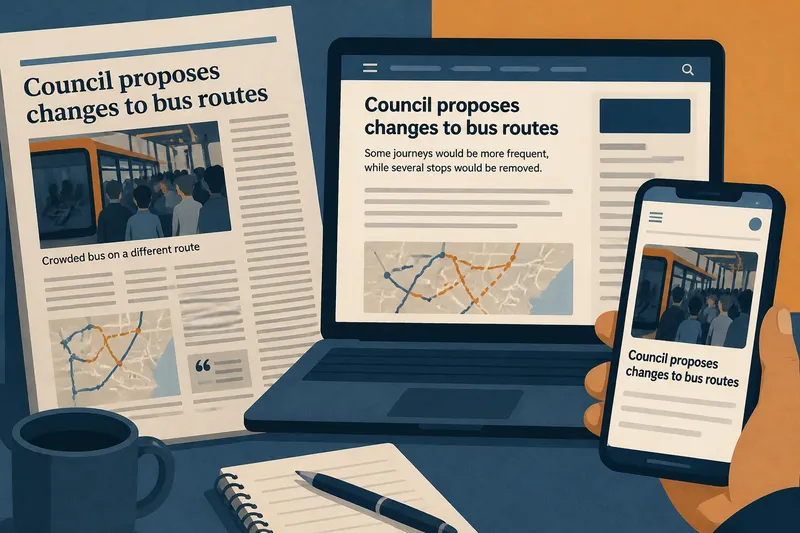
Interview, Document or Data Table? Begin with the Question
Choose an interview, document or data table by matching it to your question, then see which source can provide the answer you need.
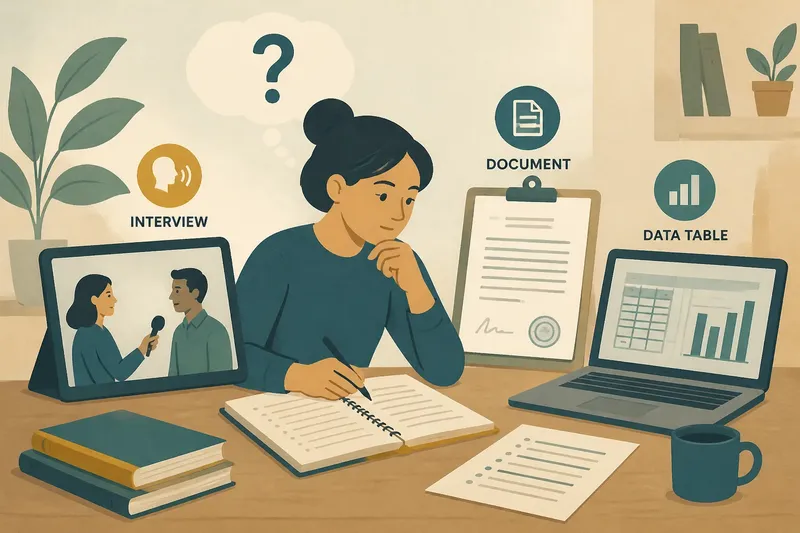
The common mistake in choosing a news source is opening the first official-looking link and expecting it to answer every question. That can leave you with a reliable document that says little about the event you are trying to understand. For an interview, document or data table, begin by asking what kind of information you need.
Frame the question
Turn a broad claim into a question with a possible answer. “What did the council decide at its meeting?” points towards a record of the meeting; “How many services were cancelled on this route?” calls for a suitable table or report.
Keep the wording open to more than one outcome. “When was the decision made public?” allows you to find that it was announced earlier or later than expected. “Why did the council conceal it?” builds an unproved allegation into the question.
Match the source
An interview is useful for a person’s account, experience, reasoning or stated intention. It records what the person says, and may explain how they understood an event. It is not automatically a complete or independently verified account.
A document is useful for what an organisation or individual formally wrote, approved, required or recorded. Meeting minutes, a policy, a court filing and a public notice each have a particular status and purpose; a proposal is not the same as an approved decision.
A data table helps with counts, categories, changes and comparisons, provided its definitions fit the question. A table of reported incidents might show how entries are distributed by area, but cannot by itself explain why they occurred.
These source types are tools for different tasks, not rungs on a scale of authority. A signed policy can establish its wording, while an interview may describe how someone encountered it. A table may show a pattern in recorded entries without explaining the experiences behind them.
Read the source closely
For an interview, note who is speaking, their role and when the conversation took place. Check whether you have a full transcript, selected clips or a paraphrase; editing can remove qualifications or surrounding context.
For a document, check the issuing body, date, status and intended audience. If a news report quotes it, compare the wording with the original when available and read the surrounding passage. A summary may leave out a condition or describe a draft as though it were final.
For a table, inspect its title, units, categories, date range and notes. Find out what counts as an entry, who supplied the information and whether revisions or missing values are explained. A column labelled “complaints” might count submissions rather than confirmed cases, so it cannot answer the same question as a count of confirmed cases.
Compare useful sources
Say you want to know whether a local transport authority formally changed the last bus time. You find an interview with a passenger, a board paper and a timetable. The interview can describe what the passenger experienced; the paper can show whether a change was proposed or approved; and the timetable can show the published departure time. Together they clarify different parts of the question, though they may not explain why a particular bus failed to arrive.
Use a second source to address a specific gap rather than to repeat the first. If the paper records an approved rule, an interview with someone affected may describe how it was applied. If one interview suggests a broader pattern, a relevant table may show what the recorded entries cover.
Choose the next check
- Interview: If the claim concerns a group but the source is one person’s account, look for another account or records that cover the wider group; if it concerns that person’s experience, attribute it to them and avoid generalising.
- Document: If the document is marked draft or proposal, find the final decision record; if it is final, check whether a separate record explains how it was put into effect.
- Data table: If its definitions or dates do not match the claim, find a table with a fitting scope; if they do match, describe the categories plainly rather than treating them as self-explanatory.
- Quoted passage: If the original document is available, compare the quotation and read the surrounding text; if it is unavailable, report that the wording comes through a secondary account.
- Missing detail: If the source leaves a question unanswered, name that question and seek a source designed to address it; if no suitable source is available, keep the claim narrow.
- Conflicting accounts: If sources cover different places, periods or meanings, clarify those differences; if their scope matches, keep the disagreement visible and seek material about the disputed detail.
Which source answers what?
Can an interview prove what happened?
An interview records what the speaker said and can provide a detailed account of their experience. For a disputed event, compare important details with records, other participants or material created at the time.
Does an official document settle the issue?
A document can establish what it states and, if its status is clear, what decision it records. It may not show how that decision was carried out or capture every relevant event.
Can a data table explain a cause?
A table can show patterns within its recorded data, but a pattern alone does not identify a cause. Check the definitions and seek other material that addresses the proposed explanation.
What if the sources disagree?
Check whether the sources refer to the same place, period, group and meaning of key terms. If they do and still conflict, describe the disagreement and look for evidence that addresses the point in dispute.
Report with precision
Describe each source for what it is: an interviewee’s account, a document’s wording or a table’s recorded categories. This makes the source’s role clear without turning it into a verdict on questions it was not designed to answer.
For an interview, document or data table, the best next step is often a more precise question, not a more authoritative-looking link. Matching the source to the task helps you explain what a report, record or set of figures can tell readers—and when another kind of source is needed.