Build a News Timeline for a Developing Story
A news timeline separates publication times, corrections and new details, helping you follow a developing story without rereading the feed from the start.
The common mistake with a developing story is rereading the feed from the beginning whenever a new alert arrives. It costs attention while making it harder to spot what actually changed. A news timeline keeps the useful distinctions visible: what appeared, when it appeared and whether it added or corrected information.
Separate the times
A story can carry several timestamps. An article’s publication time, a later update time and the time an event occurred are not interchangeable.
Record the time as the source labels it. If the time zone is stated, include it; if the source gives no event time or leaves the zone unclear, say so rather than filling the gap yourself. Use the timestamp displayed on the page, not the time you happened to read it.
Compare source timestamps
Different pages organise time differently. A live blog may place its newest entry at the top, while a social post may show when it was shared rather than when the reported event happened.
Write the source, timestamp label and time together, such as “Outlet A, article updated, 14:20; time zone unclear”. If a page shows both its original publication time and an update time, preserve both. The update indicates that the page changed, but does not by itself say what changed.
Record only meaningful changes
A new post is not necessarily a new fact. It may repeat an earlier claim, quote an existing report or add reaction without changing the account of events.
For each useful entry, write a brief, specific note such as “official statement added”, “location clarified” or “earlier wording corrected”. If you cannot identify a factual change, mark “no clear factual change” or leave the item out of the main sequence.
Keep the source of each assertion visible. A witness account, an agency statement and a reporter’s independent confirmation may concern the same detail, but they are different contributions. Name who supplied the information instead of compressing them into “confirmed”.
Preserve corrections
When an article is corrected, add a new entry rather than replacing the earlier one. Note what changed, when the correction appeared and which source made it. A narrow description, such as “spokesperson’s role corrected”, is more useful than “article fixed”.
Imagine a local transport outlet first reports that a station is closed, then corrects its wording to say that only one entrance is shut. A timeline would retain both entries, identify the corrected detail and show their order. Readers returning later could understand why the first report differs from the current wording.
Choose useful entries
A compact record works in a paper notebook or a notes app such as Apple Notes or Google Keep. Use these fields to decide what belongs in it:
- Source: If the outlet, organisation or account is identifiable, record its name; if not, mark the source as unclear and avoid treating the item as attributable reporting.
- Time shown: If the page labels the time and zone, record both; if either is missing, mark the omission and do not use that entry to establish which report came first.
- Item type: If the item is a report, statement, correction or analysis, label it; if its type is uncertain, mark that uncertainty rather than assigning a category by guesswork.
- Change: If the item adds a specific detail, clarification or retraction, describe it briefly; if no change is apparent, label it “no clear factual change” or omit it from the main sequence.
- Unresolved detail: If something remains unclear or disputed, name it; if nothing stands out, write “none identified” rather than leaving the field ambiguous.
- Original item: If you can link or name the source page, include it; if the link is unavailable, note that limitation and do not rely on an untraceable paraphrase.
Keep quotations short and use them only when exact wording matters. Otherwise, paraphrase carefully while naming who said it.
When reports disagree?
Why do two outlets give different times?
Check whether each time refers to publication, an update or the event itself, and note the source’s label. If the distinction remains unclear, mark the order as unresolved rather than forcing the entries into a precise sequence.
Should every social post go in the timeline?
Include a post if it adds a relevant claim, source or correction, and record the account and displayed time. Leave out a repost that adds nothing, so the timeline remains a record of change rather than a copy of the feed.
What if an article changes without a note?
Record the current timestamp and say that the specific revision is unclear. If the original wording matters, look for an archived or separately published version and identify it as a separate source; do not reconstruct the earlier text from memory.
When should I stop adding entries?
Pause when new items repeat information or add commentary without changing the account you are tracking. Resume if a correction, new source or material detail appears, and note where you paused so the timeline’s boundary is clear.
Work through a sequence
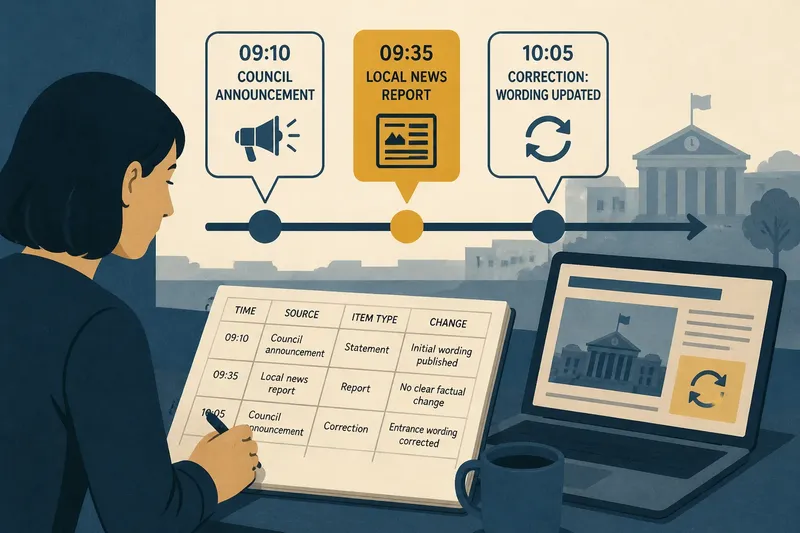
Say you are tracking a council announcement. For this invented example, suppose your notes show an announcement displayed at 09:10, a local-news report at 09:35, and a correction to the announcement’s wording at 10:05; the times are illustrative, not claims about a real event.
First, enter the announcement with its source, displayed time and item type. Next, add the local-news report as a separate row, noting whether it contributes a new detail or simply repeats the announcement. Then add the correction, retain the original entry and describe the wording that changed. The resulting record shows the order of publication and the revised wording, while leaving any unaddressed question open.
Keep the sequence useful
A news timeline is most useful when it records changes without turning them into a story the sources have not established. Put competing accounts beside their sources, and label material plainly as a report, statement, correction or unresolved claim.
When you return to the timeline, check the latest source page before relying on an entry: the page may have changed again. That small habit keeps the record tied to the current version while preserving a clear trail of how the account developed.